In my previous blog, I wrote about a way of helping students engage with extracts of oral testimonies. This process of interactive listening encourages learners to think about what they’re expecting to hear before listening, based on their pre-existing contextual knowledge. Once the extract has been played, learners are encouraged to reflect on what they heard, consider to what degree it was in line with their initial expectations, and whether they were surprised, either at what they heard or what they felt was missing. Listeners are also encouraged to come up with follow-up questions they would like to have asked.
In this blog, I consider the next stage of the interactive listening process, this time for a collection of extracts used in combination. As well as the process outlined above, learners are encouraged to draw out areas of similarities and differences between extracts, potentially relating to content or tone. This requires clear focus and concentration, with learners encouraged both to connect themselves to the extract as well as drawing out connections between the extracts.
This can be a useful analytical technique as it helps learners draw out connections between extracts that might not seem initially obvious. For example, as well as making links between what is being said, it can help create opportunities for learners to venture into the more difficult territory of what is meant, perhaps as much through what is omitted as what is shared. Similarly, learners are encouraged to become more finely attuned to how things are said, paying particular attention to areas of nuance and subtlety, such as a hesitation or shift in tone or emotional register. Something as subtle as a pause may not necessarily be indicated in a transcript or even apparent on a casual listen; only by fully committing to the listening process can deeper meanings be understood.
The role of the interviewer can also play a part here. For example, an extract that has a verbal interaction (either through question or comment) might take the interview in a specific direction, whilst an extract without any question or comment might mean a particular train of thought develops uninterrupted. Whilst there might be a case for selecting extracts without the sounds of an interviewer, arguably hearing any interaction – be that a question, a burst of laughter, an empathic sigh of acknowledgement or affirmation – serves a useful purpose to the listening process: it acts as an important reminder that part of the nature of oral history is co-construction, with the interviewer as well as the listener(s) playing an active role in the formation of meaning and understanding.
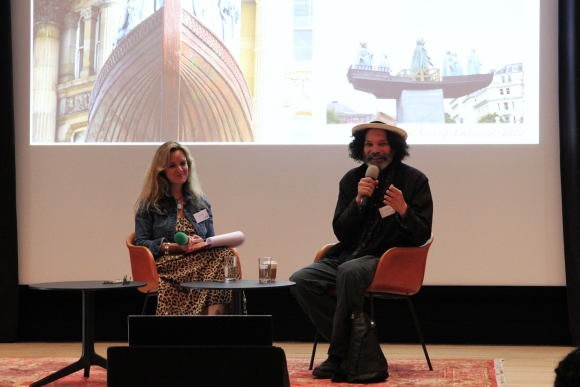
Linked to this, the future listener also has an important role to play here. Reflecting on the recording of his life story, Hew Locke discusses the importance of oral histories being recorded, in order for future audiences to be able to understand and appreciate unofficial histories forming an important part of the public record. This can be an impactful idea for young learners to grapple with: through the act of listening, they become the previously abstract ‘future listener’ participating in the co-construction of knowledge.
Once learners have drawn out the similarities and differences, they are then asked to consider whether there are more similarities and differences overall, and whether the similarities outweigh the differences. To decide, learners are encouraged to use valid criteria to help reach a final judgement. This activity is a useful device for helping learners critically engage through creating criteria for making judgements. Similarly, it is a useful way of stimulating high-level discussion as learners often have different criteria for making judgements, thus would need to make the case for why one criterion carries more weight and is more significant than another.
As a specific example, in relation to the Windrush Voices KS3 (ages 11 – 14) workshop, although there are striking differences in Linton Kwesi Johnson and Andrea Levy’s early experiences, it could be argued that the similarity in their creative work as a form of activism holds greater weight than the initially more obvious differences in their treatment at school (for a worked example of the similarities and differences approach, see Interactive Listening: Engaging learners with testimonies of Caribbean Migration part 2).
A possible extension activity involves learners coming up with their own enquiry question and then curating their own collection of clips, considering areas of similarities and differences. Alternatively, a small group of learners could be given a longer clip (e.g. 20 minutes) and asked to edit down to a more succinct length (e.g. 12 minutes). Another group could then be tasked with further editing the clip (e.g. to around 2 – 3 minutes), prompting discussion between groups around selection and omission. Learners could then develop an enquiry question from the clips that they have edited.
This kind of ‘under the bonnet’ or ‘show your workings’ thinking could help learners gain greater understanding into how historians work. If learners are given the opportunity to work through the selection and editing process for themselves, they can gain greater insight into how historians develop an argument or interpretation.
Due to the nature of the examination process, learners are constantly on the receiving end of questions in high-stakes scenarios, responding to a mysterious and opaque decision-making process with sources seemingly plucked from the ether. This process would give learners greater agency and control over their own thinking and learning, stimulating further questions and lines of enquiry and greater active involvement and engagement with how historians work.
As with the previous blog, the focus of this work is not to solely prepare students for conducting their own oral history interviews. Whilst this is clearly hugely beneficial for a range of reasons including cultivating critical skills and intergenerational and intersectional dialogue and empathy, I would argue that engaging with recorded testimonies in the classroom has great benefits in and of itself. Developing a clear process to connect meaningfully with sources from an archive through selecting, editing, comparing and evaluating a range of collection items means these authentic encounters with oral history can help empower students to think and work like historians.
Further reading
The artist’s life story: Hew Locke in conversation with Hester Westley, in The Life Story in Oral History Practice, Volume 52, Number 3, Summer 2024. Available at https://ohs.org.uk/wp-content/uploads/2024/08/OHJ-52-3-online.pdf (last accessed: 12th February 2025)
Thank you to all those involved in developing this work: in particular, thank you to Madeline White (Oral History Curator, British Library) for her kind invitation to attend a British Library Oral History/National Life Stories team meeting in December 2024, where the ideas around ‘under the bonnet’ thinking were first developed. Additionally, thank you to members of the Learning Team and Oral History team at the British Library, Mary Stewart (Lead Curator, Oral History), Kellee Rich (Editor and Critical Friend extraordinaire) and, of course, the interviewees referred to in this blog who recorded their life story.