Simon Young
Exeter, University of Exeter Press, 2022, 310 pages, £41.55
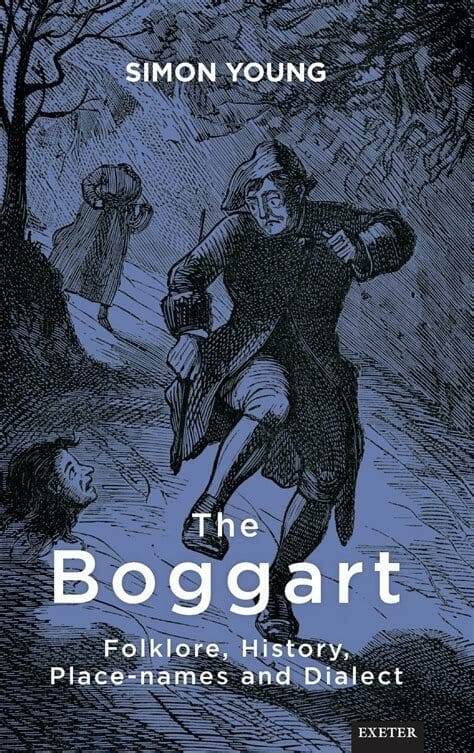
While the study of the supernatural as an overreaching narrative remains an impossible (although intriguing) task, mostly due to its enormity in contexts, themes, and approaches, the various segments belonging to it retain almost the same level of complexity. One of these fields is the observation and better understanding of the monstrous compendium which dominates the realm of supernatural narratives. Ranging between history, folklore, literature, and film, the monstrous firmly resides and prospers within the regional, national and global (sub)conscious. It is within this variety of expressions and experiences that Simon Young with his The Boggart – Folklore, History, Place-names and Dialect narrows the research by focusing on one particular phenomenon – the image and cultural relevance of the boggart.
While predominantly contextualizing the study within the boggart lore of the Victorian and Edwardian times, and therefore observing it strictly within its national and historical constraints, Young develops and meticulously constructs a uniquely original profile of this mythological being. However, what sets Young’s study of this creature and its mythology apart from similar endeavours is the wide range of sources from which he articulates his arguments. Ranging from tales, poems and theatre, as well as landscapes, people and their customs, the author manages to coordinate and extrapolate facts from both material and oral history, and in doing so surpasses a simple description of a mythical creature, and instead creates a complex memory studies project within which real life merges with myth and vice versa.
By using a variety of analytical instruments throughout the first four chapters, starting with a ‘simple’ definition of what a boggart is, and then moving to an etymological, historical, and eventually even geographical articulation of the phenomenon, the author successfully elaborates a stratified cultural image of the creature. The now-contoured boggart, through Young’s writing, becomes an existing cultural and social artefact, deeply embedded into the lives of the people living in Victorian and Edwardian times. This meticulous positioning and explanation of the myth and mythology consequently prepare the reader for the next analytical segment dedicated to a better understanding of the phenomenon within a larger cultural context.
More specifically, Young continues his scientific articulation by mirroring, whether consciously or unconsciously, some of the concerns and thoughts previously explored by authors such as, for example, Jeffrey Jerome Cohen in his famous tractate Monster Theory: Reading Culture, or The Science of Monsters: The Origins of the Creatures We Love to Fear by Matt Kaplan. In both works, as well as Young’s contribution to the discourse, the monster retains a subtle but also crucial role in the weaving of historical facts and contemporary debates. By functioning as a cultural/folkloric reference, as presented by the author, the creature reflects the habits of a society still deeply enthralled with the supernatural, while simultaneously enriching and further developing the nation’s folklore tradition.
Finally, in the last segment of the research, the book explores the metaphoric and conceptual death of the boggart, as well as its eventual reinvention and rebirth in the 20th and 21st centuries. While following the linguistic practices, and the data from an actual census (the Boggart Census), Young presents the death of the word “boggart” both in dialect and Standard English, a disappearance that was not marked by a reintroduction of the term, but instead by the widening of the initial meaning, and the beginning of the usage of alternative words. The once overreaching meaning of the word “boggart” signifying an undead/supernatural creature, as argued by Young, becomes now a goblin or fairy-like creature, and as such more prone to modern reinterpretations – the most famous one being the one presented within J.K. Rowling’s Harry Potter universe.
With all this in mind, it becomes important to point out how the text is not void of certain issues. These issues, however, are not negative in their nature, but instead are premised on the author’s insistence on creating a complex network of additional references that, while further enriching an already complex text, somewhat slow down the fluidity of the reading experience. The validation of the sheer wealth of this research is further confirmed by the author’s additional creation of three corpora, which are almost in their entirety offered to the interested readership as a free online PDF or a physical book under the title The Boggart Sourcebook.
Conclusively, one would have to struggle to find a comparative analysis of a supernatural being or myth/folklore-related creature that can be compared to the depth and detail presented in the work done by Simon Young. Young’s research successfully manages to empirically outline a myth by tracing the historical, linguistic, and cultural development of a phenomenon, and in doing so further widens the doors for both possible future academic explorations, and the adjacent methodology to be used in such endeavours. For a non-academically oriented readership, the text offers a continuously unfolding book of tales telling stories about a boggart and its gradual disappearance within an increasingly cynical modern world.