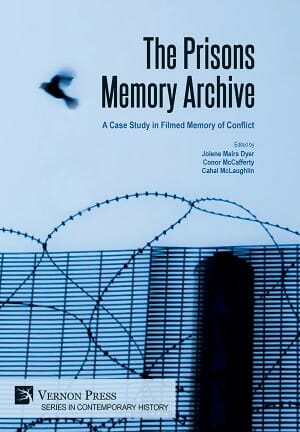
by Jolene Mairs Dyer, Conor McCafferty, Cahal McLaughlin (eds)
Vernon Press, 2022, 276pp, £38, paperback
Over almost two decades, the Prisons Memory Archive (PMA) filmed 160 video interviews, produced films, hosted screenings, public events, and created websites focusing on people’s experiences of the two principal prisons housing political prisoners during the Northern Ireland conflict (Armagh and Long Kesh/The Maze). By taking the reader through the project’s long journey (from 2004 to 2021) and with contributions from participants and academics, this book will be of great interest not just to researchers working on Northern Ireland but anyone attempting to navigate oral history projects, funding bids, archiving, or undertaking research on conflict-related trauma, human rights abuses and imprisonment. Whilst the interviews conducted for the PMA focus on the experience of individuals connected in some way to these prisons, the project’s approach and methodology, its interpretation through the creation of films, and its stated purpose make it a fascinating case study for scholars of memory studies, heritage and ethics, transformative justice, gender studies and prison education.
The book reflects the project’s multi-disciplinarity, drawing on a range of authors including a prison art practitioner, film-makers, and academics from various disciplines. It describes the project’s approach and practice, and lives up to its participatory aims — chapters written by scholars and archivists involved with the project are interspersed with short Participant Reflections from various individuals who told their story as part of the PMA project.
Though the conflict in Northern Ireland has produced a plethora of storytelling projects of various scales (for an overview of those see Healing Through Remembering’s 2005 Storytelling Audit), and oral histories of the prisons, the PMA is remarkable for two key reasons. First, the interviews follow a ‘site specific’ approach creating video footage of participants in what was left of the now-demolished prisons. The stories told by interviewees are prompted and reawakened by their connection with the physical space. Second, the project was neither state-led nor community-led, with the archive based initially at Queen’s University Belfast. Funding came primarily from the Heritage Lottery/National Lottery Heritage Fund rather than state or conflict related funding bodies. The archive created was a participatory one — participants sat on the Advisory Group, and recordings are co-owned by the project and participants meaning that consent has to be granted for any new usage of the material. Its independent and collaborative nature maximised participation whilst its academic approach and methodology ensured its longevity via permanent archiving at the Public Records Office, Northern Ireland (PRONI), something that community projects – often smaller and more limited in scope due to financial constraints – have struggled to obtain.1Brandon Hamber and Gráinne Kelly, ‘Practice, Power and Inertia: Personal Narrative, Archives and Dealing with the Past in Northern Ireland’, Journal of Human Rights Practice, vol 8, no 1, 2016, p 10.
Indeed, whilst in some ways it was an academic project, launched by academics at Queen’s University Belfast (Cahal McLaughlin) and Ulster University (Lorraine Dennis) and taking in two Northern Ireland government funded PhDs, it was perhaps more profoundly a public history project, fulfilling an unavoidably political purpose when elements of the Northern Irish and British states would not, or could not.
The role of the project in the context of a post-conflict society whose peace and reconciliation processes have been inadequate at best (‘official forgetting’ as Laura McAtackney describes it) is something that runs through the various chapters in this book. Its aim of benefiting society is emphasised by the project’s Director, Cahal McLaughlin, who writes that the audience reception to the archive and films ‘validated the methodology and outputs’ (p 9). In one of the Participant Reflections written by the former Prison Officer Ronnie White, he explains how his involvement in the project allowed him to ‘close lids on festering skeletons’ (p 220). The Participant Reflections demonstrate the vital role it plays for ex-prisoners in terms of dealing with the past and working across the sectarian divide, as does chapter ten, which serves as a meta-analytical oral history of the PMA project. Perhaps even more than most oral history/storytelling projects it was ‘both product and process’ (p 25).
But the lack of an adequate, official process for dealing with the past – beyond the fragments of short-lived legacy bodies and investigations – also create particular constraints on projects like the Prisons Memory Archive. The ‘memory wars’ connected to Long Kesh/The Maze in particular that McAtackney describes (p xx) feature in the Project Manager Lorraine Dennis’s concern that the PMA would be seen to have republican sympathies because of the significance of the prison in republican folklore (chapter two). The government limiting access to classified records, the unclear legal status of former paramilitaries, and inconsistent approach to investigating historical cases exacerbates these sorts of grievances. This is the context in which PMA has had to take great care to be evenly handed, for instance by ensuring that the cataloguing order of archival entries does not create a hierarchy (chapters 15 and 16).
Whilst not the focus of the book, political criticism is not missing — McLaughlin writes about ‘bottom-up storytelling’ filling a gap because of the ‘political vacuum’ (p 140) in addressing the past, and Laney Lenox is critical of the approach of the 2014 Stormont House Agreement’s proposals for an official Oral History Archive. But whilst these criticisms are worthy, this book also demonstrates the benefits of not being an official, top-down, state(s) led project, which would no doubt have been more exclusionary. For instance, the criticism the PMA received for giving voice to ‘perpetrators’ allows for a critical discussion of what this category means — oral history is certainly useful in understanding the social construction of these labels and in the specific case of Northern Ireland, where people often fell into both categories, ‘victim-centred’ practices can be criticised for their exclusionary nature (p 181). This has profound political repercussions in thinking about official legacy mechanisms in Northern Ireland and their narrow definition of victimhood, something that has plagued debates over the Victims’ Forum and Victims’ Payment Board.
The voices of PMA participants in this volume gives readers a better insight into the role of oral history in Northern Ireland. Laurence McKeown describes republican prisoners wanting to ‘write their own history’ (p 73), and former prisoner Michael Culbert, in praising the unique approach of the PMA, states that he does two to three interviews a week for various projects. For oral historians, this might ring alarm bells — indeed chapter eight warns of ‘ritualised repetitions’ and organisational oversight of the stories recounted by ex-prisoners, and chapter ten of the greater likelihood of participants engaging in multiple projects because of their connections to ex-prisoner networks. But in a context where the past is so contested, perhaps authenticity and spontaneity should not be the priority — how these voices come to be heard, and their motivations behind telling their story, are valid points of inquiry for oral historians. What counts in this context is not hearing untold stories as much as giving space to participants wanting to ‘impact the historical record’ (p 135). Moreover, the book details the attention given to ensuring participation from those less likely to be engaged by other projects, ringfencing filming slots (chapter two) and seeking a range of voices from across various demographics.
The most enlightening chapters in this collection are perhaps those that detail the process more than the content of the project. At times it feels almost like a project notebook in its brutal honesty over funding issues, the benefits and drawbacks of its ethical approach (it gave participants full autonomy to withdraw completely from the project and delete interviews) and the tensions between fulfilling its participant-led ethos and ensuring wide access to the material by archiving the interviews at PRONI (chapters 13, 15, 16). It is also helpfully honest in how the project dealt with the presentation of trauma in interviews and how it aimed to protect archivists and researchers from potential trauma (chapter 13).
Another valuable contribution this book makes is the critical heritage studies approach to archives (chapters 10 and 12), complementing the chapters written from the perspective of PRONI’s archivists (13 and 15). In her chapter on art-making in prison, Amanda Dunsmore reflects on the issues surrounding heritage acquisition in relation to ‘Billy’s Museum’ — artefacts that Prison Officer Billy Hull was instructed to destroy but secretly kept (chapter five). Ethical issues in relation to oral history practice are perhaps better understood in this broader context of heritage studies and it will be of great benefit to scholars and heritage practitioners alike to reflect on these issues concurrently. Likewise, by not limiting heritage to artefacts but incorporating interactions of readerships and audience (chapter nine), the influence of oral history practice on the film-making process helps consider the way in which oral testimony is presented, such as the concept of ‘contextual consent’ that Laura Aguiar writes about in chapter eight.The latter chapters of the book will aid considerations about archiving in post-conflict societies, where archiving is not just about preservation but contributes towards memorial politics, allowing the past to co-exist in the present (pp 161-65). The multiplicity of participant voices and the minimisation of the interviewer’s voice that the PMA has sought in this sense moves away from any attempt at a singular narrative that hides contemporary debate over the past, such as that sought by official state-led proposals, and allows for the more democratic and contested understanding of post-societal transformation that this volume exhibits. Though some of these specific contextual considerations are particular to the case of Northern Ireland, the approach that this book details will be of great interest to anyone who takes seriously issues of archiving, ethics, and integrity in large-scale oral history projects.
Footnotes
- 1Brandon Hamber and Gráinne Kelly, ‘Practice, Power and Inertia: Personal Narrative, Archives and Dealing with the Past in Northern Ireland’, Journal of Human Rights Practice, vol 8, no 1, 2016, p 10. ↩︎