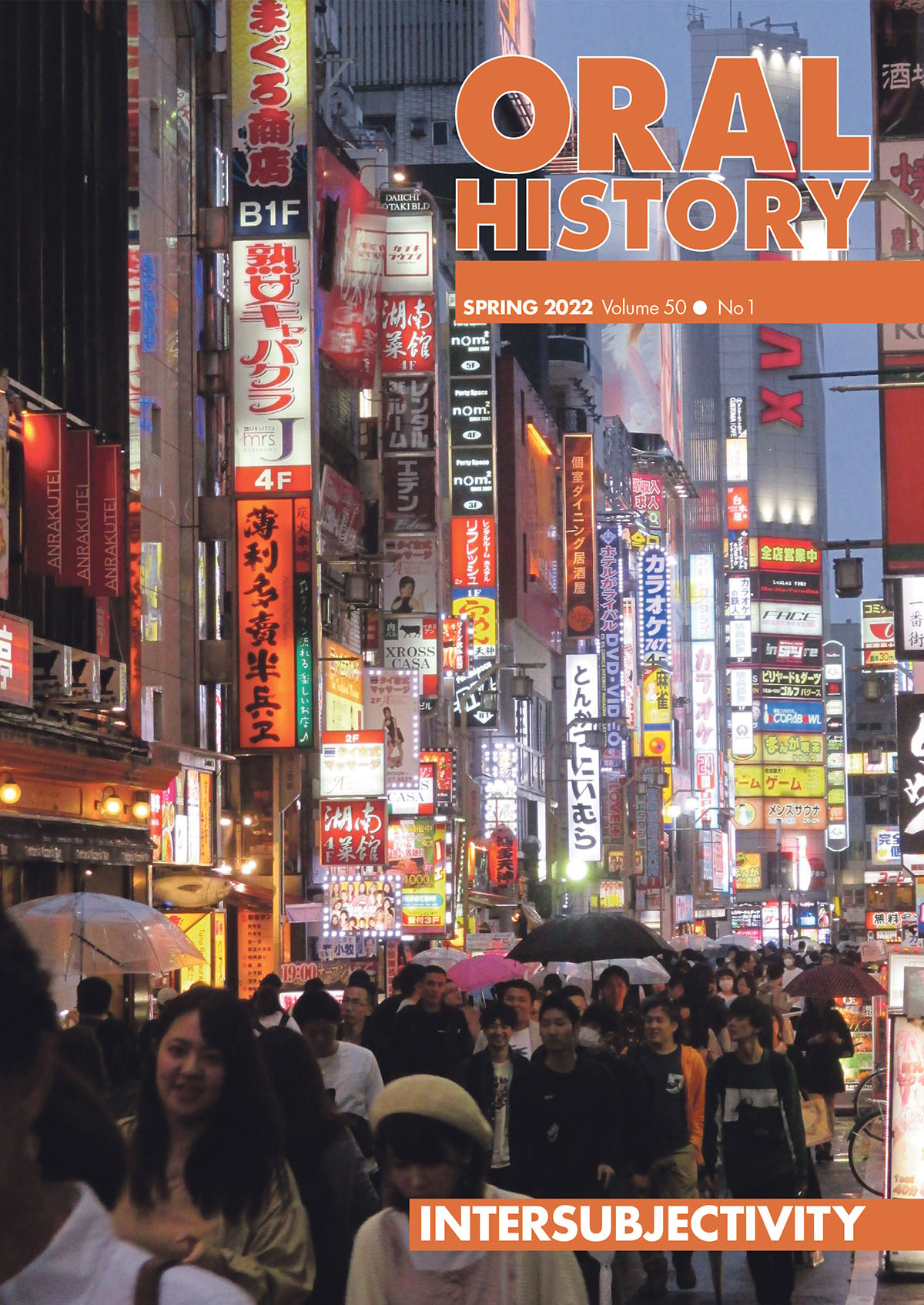
Intersubjectivity
Volume: 50, Issue: 1 (2022)
Articles
Reflections on remote interviewing in a pandemic: negotiating participant and researcher emotions
This article explores the authors� experiences of conducting remote oral history interviews during the Covid-19 pandemic for a project that had started in 2017. We consider differences in interviews conducted before and during the pandemic, the emotional impact of remote interviewing during a global public health emergency, and potential reasons for the heightened feelings of researchers and participants. We attempt to disentangle those effects attributable to the circumstances of lockdown, and those likely to be experienced by oral historians conducting remote interviews in more usual contexts. We end with some reflections on negotiating remote interviews, a challenge that increasing numbers of oral historians are likely to face in a post-pandemic world of changed work and communication practices.
Author(s): Tracey Loughran, Kate Mahoney and Daisy Payling
Keywords: Covid-19; pandemic; emotion; agency; online disinhibition
The accidental migrants: analysing the outward migration narratives of British female graduates to Japan
This paper explores the narratives of British female graduates who moved to Japan for the purpose of work. It analyses their outward migration stories, finding that many sought to overcome a lack of self-confidence and a perceived dearth of career opportunities for female graduates at home. It finds that they were additionally influenced by male colleagues and boyfriends, and by a cultural trend towards going abroad after graduation. Japan was not a desired destination and many knew little about it, viewing it as a liminal space where they could gain skills and work experience that could grant them access to fulfilling careers on their return home or on migration to a third country. Narrating their migrations as �accidental� highlights their stories as gendered testimonies. Unlike male informants, the women perceive a lack of agency in their journeys, necessitating �tacking� strategies to achieve life goals. They also appear to reject a collective identity as migrants or a sense that their journeys are complete.
Author(s): Susan Karen Burton
Keywords: British; Japan; migration; gender; identity
Listening intersubjectively: re-analysing migrant rights activism in �new� and �old� oral history collections
This research stems from a desire to add social and emotional detail to earlier assessments made by Marxist scholars about the work of migrant rights activists in pre-multicultural Australia (1960s-1980s). While analysing interviews within two very different oral history collections, the research became an exploration of the timeliness and future use of oral history collections in historical research. How do researchers productively draw on and build histories with oral history collections created in vastly different political and social contexts? This question is worth exploring in relation to oral history collections formed in or after politically contentious contexts and with politically active interviewees. Here, oral histories are read (or re-analysed) in a context for which there is a constrained or different discourse around multiculturalism, and around the role of men and women in public life. This type of re-analysis becomes a matter of listening both intersubjectively and dialogically. The aim is to cast a light on a history of welfare rights and social activism in migrant working-class communities, and thus explore their alternative visions of multiculturalism espoused by the migrant men and women working on the frontlines.
Author(s): Alexandra Dellios
Keywords: multiculturalism; migrant rights; intersubjectivity; re-analysis; welfare rights; Greek-Australian
�Rabbi, don�t you think she looks like one of us?�: the intersubjectivities of age, politics and faith in Holocaust survivor interviews
In interviews with Holocaust survivors conducted as part of a project on support associations, it became apparent that interviewees made assumptions about the interviewer�s identity, including age, religion, marital status and political views, which appeared to lay the grounds for development of rapport. This article examines how these assumptions were informed by the intersubjectivities of the interview and contributes to a discussion of how �outsiders� can establish rapport. This is particularly important with communities that have experienced widespread trauma and discrimination, where there may be a reluctance to trust outsiders with personal information and insight into their experiences. Additionally, this article will examine the opinions of survivors on contemporary issues through the lens of how life review manifests in these interviews and becomes cross-referenced with current events, interlinking with the intersubjectivities present in the interview.
Author(s): Ellis Spicer
Keywords: intersubjectivity; Holocaust survivor; assumptions; religion
I, of the storm: volunteers and Australia�s response to the HIV/AIDS crisis
The education programmes and harm reduction strategies devised and delivered by community-based organisations were the foundation of Australia�s effective response to HIV/AIDS. But owing to their absence from the historical record and published histories, we know little about the people who made possible the success of these organisations: the thousands of volunteers who cared for the sick, packed and distributed condoms, staffed needle exchanges and provided information and support on telephone lines and so on. Through the oral testimony of these volunteers, we come to understand Australia�s response to AIDS in a different way and appreciate how the epidemic and the act of volunteering can have life-long consequences, even for people who were not �infected� or from the communities most affected by AIDS.
Author(s): Paul Sendziuk
Keywords: HIV/AIDS; volunteers; AIDS Council; sexuality; needle exchange
�With care in the community, everything goes�: coproducing oral histories to re-examine the provision of care in mental hospitals
This article draws on oral histories coproduced with former patients of two state mental hospitals in Nottinghamshire, collected thirty years after their closure. The oral histories reveal the mental hospitals to be more welcoming and relaxing environments compared to the current system of acute inpatient services, which is oriented towards crisis management. Former patients found accessing meaningful occupation as well as the ability to move within internal and external institutional spaces to be central to recovery. They expressed a sense of loss of inpatient therapeutic environments when undergoing crisis following deinstitutionalisation and the advent of community care. The findings have important implications for the historiography of psychiatry and bear on current mental health policy.
Author(s): Verusca Calabria
Keywords: mental health; institutional care; deinstitutionalisation; community care; participatory action research
Learning
Oral history in higher education in Britain, c. 1969-2021: historical perspectives, future challenges and opportunities
This article is intended to open a debate on oral history in higher education and follows on from a series of articles in this journal exploring oral history in schools. While university-based oral history has grown in significance, the number of oral history posts in higher education has remained negligible. Job insecurity and casualisation, widespread in universities, have been particularly evident among oral historians. In Britain, this is in part a result of the way oral history has been funded but is also a result of historical attitudes among oral historians. The article concludes with some suggestions about how oral historians might begin to bridge the gap between demand and resourcing within higher education and build stronger collaborations.
Author(s): Graham Smith
Keywords: universities; casualisation; professionalisation; impact
The pedagogy and practice of listening to Rwandan exiles and genocide survivors
Oral history is one of the few fields of qualitative research to regularly archive our interview recordings as a matter of course for future access. Yet despite our propensity to archive, oral history still privileges fieldwork over secondary analysis of archived interviews in our methodological training. This article reflects on the pedagogical value of sustained listening in the context of an undergraduate oral history course that focussed on the Living Archives of Rwandan Exiles and Genocide Survivors, an online archive developed by the Centre for Oral History and Digital Storytelling and Page-Rwanda in Montreal. Secondary analysis of oral history interviews raises unique methodological challenges in teaching and research. The article explores this course from multiple vantage points and considers the importance of individual positionality when listening.
Author(s): Steven High, Elizabeth Tasong, Felipe Lalinde Lopera and Hussain Almahr
Keywords: Rwanda; pedagogy; listening; secondary analysis; archives; genocide
Reviews
Archives and museums: social change and social justice
Author(s): Craig Fees